By Petros Cowley
Another very important story for the edification of all mankind. (This one really is total rubbish. Crap and inexplicable. A disturbed laziness of idiocy. A true poverty, a pestilence, a curse. I dare you to read it, you fucking coward.)
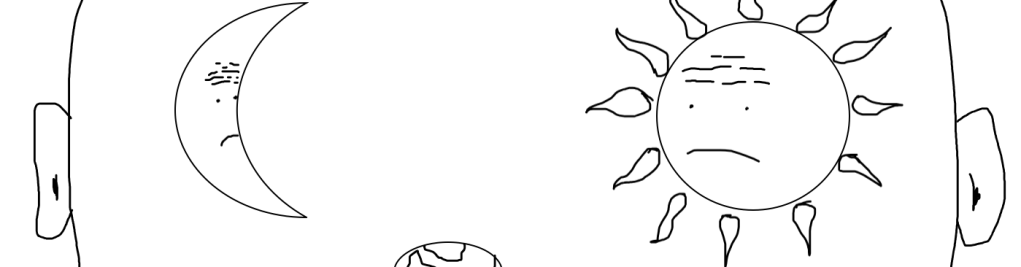
1.1
It was high tide on the men’s toilet floor. Lord Ethelbert Pantaloon in largely arching movements manoeuvred by usage of two of his legs. Splot, went the looser of his steps. He manoeuvred to the mirror to loom broodingly perusing his face. He was ageing faster than he would ever get used to, time oozing away, in the sallow loo light illumination. That unlovely thing, it was him.
He removed his glasses. A red groove he found construed, bruisedly accrued, over his nose bone. Both pairs of eyes, reflected and otherwise, moved to view each other’s forehead.
They saw the shores of wrinkle shift and rise and fall and twist.
Again they moved. Again they moved. They moved into an ovoid. They rooted into their ovoid. They moved within it into another two.
They grew into a face. A face grew into a face. A face grew into a face into a face his very own face but rather a lot younger. It grew. It aged. It wrinkled. Another face!
Lord Ethelbert Pantaloon gasped at the face in the face in his forehead wrinkles! The face shrunk back to reveal a body, a landscape. It rained and it blew, as he struggled out into the country. At the sides of the path, the trees fell up leafless from the mud. He was all alone, walking, squinting aside into the endless fields of mud to protect his eyes from the rain jetting upwards.
- Hello, said a voice to him.
He looked ahead, and there was a long black coat with a little gloomy face poking out at the top. The wrinkles on the old man’s forehead were shaped as W’s, and his thin grey hair flapped up and down in the gale.
- Hello, he said to the old man. What is your name?
- My name? My name is Francis Ford Coppola. This old man, Francis Ford Coppola nodded to him here. There was a pause. Now have a good look at these.
Francis Ford Coppola then pulled his sleeve-ends out from the deep pockets of his coat, and at the ends of these sleeves were his hands, pale and age-spotted, and in each of his hands were vegetables. In his right hand, a beetroot and a swede, and in his left hand, a potato and a turnip. He bent down and lined them up alphabetically on the path before himself: the beetroot, then the potato, then the swede, and last of all the turnip. It was a very pleasant display that he’d set up for the two of them to appreciate together. And so they did for a few seconds. But then there came a frightful gust of wind and the beetroot started rolling.
- Aren’t you going to go after your beetroot? asked the younger to the older man.
- Let them go where they must, Euripides solemnly replied.
- Hmm. Well, so much for the beetroot.
They watched the beetroot wander off into the bramble at the side of the path and burrow its way in.
- So much indeed, continued Euripides. But hurry now, I have other places to get to.
- Ok. I think I’ll choose the potato, then.
- You think? Why do you think that?
- Well, I don’t personally like swedes or turnips.
- And how about impersonally?
- Impersonally? Impersonally, I don’t care much at all.
- Well rescued. So, the potato it is. As you must.
Boudica bent back down and collected his swede in one hand, his turnip in the other, and shoved his sleeves back into his pockets, turning back around and wandering off ahead, where the path disappeared around a bend, behind a dark brown hedge.
- A potato! Said the younger man, alone again, picking it up to inspect the thing, wiping it dry with his sleeve – in vain. And a bloody fine one too!
So with the potato thoroughly embedded in his pocket he turned around and headed back northward to the town, the rain turning with him, pouring downward now – though just as forcefully. A branch up on a tree to his left flailed in the wind, and its one brown leaf was cast off ahead into the murk.
The leaves came down in brown piles at either pavement of the bridge. His boot came down on top of the pile with a squelch. The wind suddenly charged from the east. It tossed up the leaves and threw him against the heavy stone balustrade. He clambered back up to his feet and with a firm grip looked over upon the canal, all the leaves settling down onto the taupe water surface and continuing with their courses, slowly rounding the bend. The surface wasn’t rippling, so he continued along the bridge and at the end turned early to follow the path down to the canal-side. It was a slightly longer route taking the canal path all the way from here, but he could avoid the wind down there, he thought; and for a while he did.
Down by the canal, the moist gravel path ended suddenly to the water, the water, taupe with its banished appurtenances out-poking: a trolley, a traffic cone, a red can, and it was a horror to see such colour emerge in that place; he wished the water to drown it all. There was a barge parked by the path and on the roof of the barge a dog, poised like the Sphinx, eyeing his approach, obliquely, and as he passed, he said,
- Hello dog!
but the dog in his language of barks told him more or less to keep it moving. And so he did.
He followed the path around the bend and at once the wind resumed, very nearly sending him down into the water. The rain came flying up from the water, lashing at his face. He had to turn his head away to the vines writhing up the bank at his right between him and the pavement above.
- Hello, shouted a voice.
He struggled his head forward to get a look at the individual. The man was soaked in his brown suit.
- Hello, he shouted back over the wind. Your name?
- Simone de Beauvoir, responded the man, pulling the top of a carrot shyly into view from the within of his streaming blazer. A glimpse of the potato, a nod, and one word were given in response.
- Likewise.
- May fortune be ours alone and numerous.
- Indeed.
And so Simone de Beauvoir departed from him. He turned his head back aside to the brambled bank, the weather unabating, and battled on forth along the canal-side. By green and brown and black he watched the bank hobble by. Behind the leaves, the vines, the bramble and branches, spread a pocket of darkness, and within that darkness, suddenly, the blinking of two eyes.
1.2
- So I thought I’d tell you about my morning.
- You what?
- I said I thought I’d tell you about my morning.
- Why?
- Exactly.
- What?
- So I was out drinking and whatnot, drinking and whatnot with my friends last night, my very good friends. And you know how it is with drinks – you let one in and they start bringing their friends along, and they theirs, and so on. Very awful guests in the body.
- Perhaps you should get into politics?
- Eh, I lack the charisma. But let me continue. At the bottom of all these drinks shone the sun, blindingly, as I lay on someone’s sofa. Who knows whose sofa it might have been. It was a sticky sort of sofa and it was trying to undress me – my shirt was rolled up beyond my nipples and my flies were down, one boot pulled off. So I got myself off that thing. I collapsed to the floor, holding my head in an agony. I looked up and saw a pigeon, but the pigeon saw not, pecking at the gutter across the street, doing pigeon things. It had a very menacing way about it. I crawled on all fours to the sink. ‘Twas there I would get a drink – water; lovely, cool, water.
- And then what? Is that it?
- What?
- What?
- Yes, you heard me correctly.
- Does anything else happen?
- Of course. Plenty happens. Every day, plenty of things happen. You just have to notice them properly. Let things take their course, pour out in their own ways, like Water. One always finds himself with the right amount of Water. Do you think much of it – Water?
- A fine liquid – where would humanity be if not for water, I say.
- Indubitably.
- Every creation, every innovation, civilisation – we’ve water to thank for all that.
- Well said, well said. You are more intelligent than I thought. Perhaps I don’t regret telling you this story.
- That’s not a very good compliment.
- No, but I’m very sorry.
- A good enough apology, though. Do continue.
- So I thought it a wise scheme to extricate myself from that flat before any other bits of furniture made an attempt at my trousers, my secret nakedness.
- Indeed. And did you act upon that scheme?
- As a matter of fact, yes, I did. I left these people’s flat, whoever they might have been, and walked downstairs, and at the bottom of the stairs was the door, and through that door shone the sun, and through the entrance of an alleyway I ran, and through my mouth came a healthy five years from the end of my life span. I was feeling very light on my feet after chucking all that up in there.
- Very good of you. More considerate to the pedestrians to have done it in an alleyway. Now, as you seem such a shrewd and discriminating fellow, would you help me here with these. Which one?
- Well, obviously those. Why not get a bag of those, too? A very big one.
- Very well, thank you. I’ll put them in. Continue.
- And I was in that alleyway for too long. A crisp packet came out from under the bin and started chasing me.
- Pardon? Did I hear you say a crisp packet?
- Yes, a crisp packet. There was a gust of wind, and it flew out from under the bins in a really very menacing sort of way, came right towards me, flaring itself wide – a sort of intimidation tactic, no less. So I scurried back out into the street. Was I safe there?
- I don’t know. From what?
- No. I thought I was at first, but after a couple dozen meters, I looked back and saw the thing poke itself out of the alleyway, turn to look at me. I hurried on and stuck myself in amongst the crowds around the Sunday market stalls. That should lose him, I thought. What place has a crisp packet buying scented candles and Peruvian bracelets? But was I right?
- I don’t know that, either.
- No. Every now and then I would look back over my shoulder and catch a glimpse of this little green devil darting about the ankles of the crowd. He kept his distance back there, thought I couldn’t see him. What’s it called in those films when a car follows another without wanting to be seen?
- Tailing, I believe.
- Well there we go, this little green bastard was tailing me. I was almost running here, but I couldn’t go so fast – I felt dizzy, remember. In fact, I wanted to stop and collapse. But I was to afraid, you see. Fear is a great motivator of men. About halfway down the parade, or thereabouts, it’s a left turn for Regent street. You know it?
- What?
- Regent street.
- Perhaps if I saw it.
- Do you know that pub, the woodland tavern?
- Hmm…
- An old looking building. Black and white, tufts of greenery, a gate. Not very busy. A bittersweet sort of feel about the place. Ah, it’s on a corner! Left as you go up the parade. Half-way up. A little way off.
- Yes! Yes! I know the one! I’ve been there! Not very often.
- Excellent! That really is excellent! Most perfect! Now, do you remember the road it’s on well, coming off the side of the parade? I think Murphy’s is on that road earlier on, but I’m not quite certain on that.
- Just about. You’d never find me in Murphy’s, though.
- That’ll do! No, no, that one, much better value for money.
- Are you sure? Look, that one’s 600g for £8.50, that one 500g for £10.
- Yes, but that one’s three for two.
- What on earth am I going to do with three of them?
- I’m sure there’s something. You can’t be that lacking in imagination, now.
- Yes, you’re right. I’m sure I’ll think of something. Yes! I’ll get the three. Now, what about this Regent street.
- I’ll tell you about this Regent street.
- Well go on.
- As you wish. So I turned the corner as I was passing ahead of a large group of people. Trying to play a little trick on the crisp packet, you see.
- Very artful!
- And did my trick work?
- No.
- No.
- What?
- No.
- Yes?
- No! I mean, yes!
- It did work?
- You can be sure it did.
- Fantastic!
- I know! And anyway, I live somewhere up there, up at the top of the hill. Or rather, no I don’t. But a friend does. An acquaintance. There’s lots of nice houses up there, but his is rather ugly – he’s renting a little room up there in the loft. And there I was going. I looked back and saw the crisp packet falling for my cunning little rouse, watched the little aluminium imp go straight past the turn and continue up the parade! Can you believe that?
- Well, you tell it in a mighty convincing way.
- The truth is often convincing. So what is it that one does when they’re trying to get to the top of the hill?
- They walk up the hill, of course.
- Yes, something of that sort, one might suppose. Only things don’t always work out as one supposes. I went, quite relaxed now that I’d got that nefarious bastard from hell off my tail. Walking along- no, a better word. How does one walk in a happy but sleepy way?
- Hmm… I don’t know if there’s exactly a word for that. Strolling, or sauntering, maybe.
- Yes, well I was busy with those on Regents street. Looking into the windows, into the crowns of the trees, letting my eyes bounce from one treetop to the next. Well, I say crowns, but these trees had no leaves, looked like they were balling their fists up at me.
- That’s what happens when you chop a tree’s branch; they put up their fist. That’s what keeps trees living so long: Vengeance.
- Is that so? And do these trees often get to wreak their vengeances?
- Of course. And these tree fellows are very well organised about it. What do you think global warming is? It’s the trees getting their revenge. We keep chopping them down, you see.
- Incredible!
- But please, we must hear what happens next.
- So as I said, I was walking up the hill in a happy but sleepy way, strolling, or sauntering, looking up at the angry tree tops, up into the sky. I felt better and better, lighter, the headache going. But as I said before I was and remained quite dizzy – at least if not in pain – so looking up into that glorious blue sky, I fell into a real reverie of sorts. My thoughts went up into that sky, and, when I looked down after some time, I saw that so had I.
- Excuse me?
- I will. Now what had happened, you see, is that after I’d breached the top of the hill, I’d continued rising at the same slope. I looked to my left and there was an upstairs window, within its frame a woman changing! A woman and her breasts! Strange things are breasts. Obscene, needless. I thought it a little rude, you know, invasive, so I turned away and felt myself slowly sinking to the pavement. One disastrous ankle flapped about the kerb and threw me over a car’s bonnet. I collected myself. I looked around. No. Nobody. Nobody had seen what had happened. I pulled out a cigarette to calm myself here, and smoked it up greedily. I threw the stub down onto the grass patch and sent my heel down after it. Now what happened when my boot met the floor?
- I don’t know.
- I went up into the air again a meter or two with the force of the impact! And once again, I came down nice and slowly, landing properly this time. So I did it again, kicking once more when I got into the air, and went twice as high. But I was a little unsteady in my top half so the third time I tried to use my arms, and sure enough, it was just like swimming. I got the hang of things very quickly. The air too is a fluid after all.
- So where did you go?
- I thought I’d go and taunt that crisp packet, of course. Like the trees, I rose up towards vengeance. I found the bastard crawling back into his alleyway.
- What did you say to him?
- I said: Hey, you! Can’t get me now, can you, you dick! But a woman who was passing looked up horrified. I told her I wasn’t talking to her and she told me to keep my voice down, wandered off, tutting. The crisp packet hadn’t heard me. I guessed they couldn’t hear or something at the time.
- Well they don’t have ears.
- Have you ever searched a crisp packet for its ears?
- No.
- Think of a snake, or a fish, do you see any ears on them?
- No.
- And yet they hear?
- Yes, I believe so.
- Hmm. Press-is-ully. In any case, this crisp packet hadn’t responded to me, so I went into the alleyway and hovered by his bin, gave it a right boot and called him a bastard. And out he came, with three of his friends now! Flared themselves up like the first time. But then, me thinking I was nice and safe hovering up there, a great gust of wind swept through the alleyway. What happened next?
- Why do you keep asking me what happened to you?
- It’s a very cheap way to keep the listener engaged, keeps me from reducing myself to eloquence and skilful oratory.
- Ah. Oh, do you think I should get the large one, or the small one. I’d get the large one, only they go off quickly. What do you reckon?
- Well if the large one goes off quickly, get two of the small one.
- Unfortunately, the small one goes off just as quickly.
- Then ask that man.
- Who?
- Him.
- Hello.
- Yes.
- Which one?
- That one.
- Thank you. So what were you saying about this crisp packet?
- What are you talking about?
- The crisp packet, the one chasing you around town this morning. You walked up a hill but kept going, flew up into the air, flew back to make fun of this crisp packet. Then the wind blew through the alleyway. I assume something bad happened next.
- What on earth are you talking about, man? A crisp packet? Chasing me? I’ve never heard such nonsense. Have a pleasant shop, now.
Exit character one. Character two finishes his shop and leaves the supermarket, walks through the exit. Character one is waiting outside with a big smile on his face.
- Haha! Did you like my little joke? Now put down those bags, let me show you how to fly.
- But I can’t just fly off and leave my shopping on the ground, someone will take them.
- Well give them here. I’ll put them up on that roof to keep them safe.
- Ok. Here you go.
Character one blows a raspberry and “flies” off down the hill with Character two’s shopping, escaping him, Character two shouting after him. He is next seen entering the Waterstones without the shopping. He sees a woman inspecting a work of some kind.
1.3
The door swept in through the fluid. Wading through the room was now one Chancellor Mark Margariner. He regarded the Lord Pantaloon and asked him what was lasting him so long there in the loo. But basking rather in the wrinkly art of the mirror glass the Lord Pantaloon spoke not. Thither did Mark Margariner manoeuvre to the mirror to bask too in the wrinkled face of Pantaloon.
- What on earth! remarked the chancellor Mark Margeriner when he saw what was elapsing upon the other’s forehead.
So he moved his glance from Pantaloon to himself, Mark, and on his forehead too did the wrinkles start to move, for so intense was his frown at what he’d already seen. A face by a face in a face in a face by the face of another but not those two most new not his own but another two walking through the supermarket, having a frivolous sort of chat.
The men in the toilet watched their foreheads in silent terror.
2.1
A dribble of fluid from above. It splashed upon the surface of the stump, settled itself in lava droplets; they dwindled, absorbing into the wood. By the motionless light of one candleflame, four faces. Salivating mouths slurped quietly. In the covert depths of an earthen grotto, a family of four sat around a tree stump with their last few mouthfuls of dinner in their flasks – a mother and father, two daughters of no more than thirteen. There sounded a crunch from the distant outside. They attended a while to the silence.
- Come on now, Satan, the father whispered to his younger daughter. Finish up your soup.
- I don’t want to.
- Do you want me to feed it to you? asked the mother, gesturing over the stump. But the father gave her a stern look and the mother resettled herself, darkening as she drew away from the flame. Satan pushed her flask of soup aside and collapsed her small head in its place.
- So you wish to starve then. So be it. Starve. You know how little we have to eat.
Satan wept. The mother put an arm around her, though retracted it. The other daughter finished her soup.
- Can I go and read now, Daddy? Albert Einstein asked.
- Show me your flask. … Ok. … He returned to Satan. Satan. Satan raised her head from its puddle of tears. Go on, off to bed with yourself now, too. She rose and scuttled off after her sister into the darkness. There was a rustling back there, then silence. The mother and father remained. They looked up into each other’s eyes.
- Maurice Merleau-Ponty, the Mother said.
- Grigory Perelman, the Father responded, nodding. The mother, Grigory Perelman, turned her head toward the girls’ bedrooms and listened, listened for a number of seconds. Silence. She smiled at Maurice. He smiled back, but lowered his head.
- Let’s count, said Grigory. Let’s make sure. Maurice hummed contemplatively as Grigory unpacked her coat. She spread across her half of the stump one, two, three, ten, fifteen, twenty, twenty-one vegetables, mostly turnips. What’s wrong, Maurice?
- Nothing, nothing. I’m just tired. With a smudge of carelessness, he began to unpack his coat in turn. He erected on his half of the stump one, three, six, nine, twelve, fifteen, eighteen, twenty vegetables, once more mostly turnips. As we thought. He looked down again. Hmm. That one, he said, pointing at a red onion.
Grigory Perelman smiled weakly and pushed the onion across the stump to Grigory Perelman, who took it in his hand and with a fleeting grimace inspected it. He put it back down. Maurice lowered her head to meet his eyes, to infect him with a smile. His mouth moved, but very little, and he turned his head away, exhaling through his nose.
- Come on, choose, he said.
- The onion again.
He exhaled through his nose again and did smile now, sliding back the onion to Maurice Merleau-Ponty. She, Grigory Perelman made as though to bite into it but settled it down, laughing silently. Maurice smiled and picked his nose, told her not to be vulgar, looking off towards the girls’ bedroom. A more sombre expression fell upon him as his eyes moved back to Grigory who was now looking over at the girls’ bedroom herself. She kept her face turned that way a little longer, squinting at the silence. The candle in there was extinguished.
- It seems Einstein isn’t reading, she said. It seems they’ve gone to sleep.
- Yes. It seems they have.
- And look, I have one more.
- Yes. It seems you have. Maurice shuffled back in his chair, slightly.
Grigory shuffled around the stump and spread her hand across the nape of his neck, caressing his skin. His head was turned away.
- And you know what that means, she whispered in his ear. I think I know what might help. She stretched her other hand back across the stump and grasped one turnip, raised it towards him, but her sleeve swept through the flame and extinguished it.Invisible, he was heard as he rose abruptly.
- Not tonight, he whispered. I told you I’m tired. Leaving her in the darkness, the smell of unseen smoke trails, he manoeuvred away into the back of the grotto and slipped into a hole, sealing himself in with a cover of leaves that rustled, then silenced. Grigory Perelman relit the candle with a match and remained by the stump, sighed, rolled the turnip once in her palm. She clutched it to her bosom. She gazed into the flame.
Ensconced in his bed of leaves, the candlelight stealing in dimly, sparsely through the interstices of the hatch, Maurice reached around himself as quietly as he could. There it was. His body heaved with longing as he touched it again, as he put his skin to its. He brought it to his lips and felt with them the teeth marks around the cross section. As he sealed his eyes, the penetrating candlelight turned to honey in his mind. His chest sank in a taste of ecstasy.
But Grigory Perelman was soon approaching with her flame. Maurice stashed the carrot end back into the withering foliage beneath him and awaited her motionless. The hatch rustled open and she clambered in beside him, settling down her coat at her far side, propping what remained of the candle into a puncture in the cavern’s wall.
- You don’t mind if I keep it on to read for a little while? Grigory asked, untying her hair and letting it flow out at her shoulders; Maurice noticed a fleck of grey amongst the red, but said nothing. It’s more comfortable in here with you. You’re nice and warm. She took out her book and began to read before Maurice had responded.
- What’s that? he asked.
- Anna Karenina.
- What’s it about?
- Farming.
A pause.
- Don’t you want to sleep? It’s not like we can stay here.
- I can’t. And it’s not like that matters. We can’t leave until dark tomorrow, anyway.
- Hmm.
- What?
- Well, all these books you read about farming. It’s just not very realistic is it?
- How do you mean? She turned to him. He was looking away.
- You go planting all these fanciful images of agriculture into your head, and you lose… Oh, never mind. I’m just being grumpy. I’m going to sleep. Enjoy your book. Maurice leant across and kissed Grigory on her cool forehead. Grigory smiled, dimples pressing into the freckled flesh of her cheeks. Maurice lingered upon her image for a moment, searching for a smile of his own. But he turned away. He lay with wide open eyes, waiting for her to fall asleep. He reached slowly into the foliage.
Finally, he heard her put down her book. She blew out the candle and nestled her head down into the leaves. Maurice mouthed the word soon, smiled with only his mouth, and waited, waited…
Into obsidian night, Maurice Merleau-Ponty emerged from the leafy bank beside the canal. He looked either way: once, twice, thrice. There was no light, but for that of one star in the southern sky. A cloud wrapped itself around the star.
Stooping forwards, he hurried away along the waterside, away from the town.
A second star now apparent in the sky he arrived at a hatch in the centre of a barren field, black beneath its cover of night. He stopped a moment, looked back towards the treeline. A frog was croaking somewhere nearby. He frowned, but he failed to maintain his concern, started to giggle, and rushed over towards the hatch, swept aside the leaves and knocked thrice. It shortly slid open, and a grapefruit light trailed up from the gap. Two eyes peered up, ripe and aflicker with reflections; a hand beckoned him down. Down he went, closing the hatch behind himself.
The grotto was small and circular, three candles burnt upon the walls. Muddy footprints pasted around its hem, a white cloth lay draped over a central tree stump. The place smelt mildly of sweat; hot and peppery. Maurice pushed the young man back over the stump and tore apart his robe. The young man’s arms flung back, his robe flayed out over the sheet and exposed a hairless naked body, two carrots and a swede strung across the upper abdomen.
- Euripides, now? he giggled, adoring the young body.
- What are you tonight?
- Maurice Merleau-Ponty.
- Oh dear! the young man, Euripides, giggled ironically. But you have almost seven times as many vegetables as me! Both men smiled in their one subterranean guilt. Maurice pounced upon Euripides, weighed upon him with all his body. He put a finger to Euripides’ smiling lips and slipped away back down his torso.
- Shh! I’ve been suffering days for this! The swede! The swede! Euripides sat up and engulfed Maurice in his shadow. Maurice yelped, but his yelp was quickly stifled. The candles flickered. The frogs were croaking outside.
Twenty minutes later, the men lay in each other’s embrace on top of the stump. Maurice Merleau-Ponty brushed a finger across Boudica’s cheek.
- You know, Maurice began to whisper, I’ve kept the end of the carrot from last time. Tonight, my wife had more. I snuck away from her and lay there on my own, just holding it, that carrot end, and thinking of you.
- Where do you hide it? asked Boudica, twirling at Maurice Merleau-Ponty’s chest hair.
- I’ve got it on me now. Look. Maurice rose into the candlelight and approached his coat which lay in a heap on the floor. He searched through its pockets. He grew somewhat frantic.
- What’s wrong? asked Boudica.
- I can’t find it. Maurice dropped the coat and sank back against the stump, Boudica’s head appearing over his shoulder like a solitary devil. I left it in the bed. I left it in the fucking bed! I’ve got to go back. Maurice made to rise, but Boudica pressed down at his shoulder, manoeuvred himself around to straddle Maurice by the shoulders. The warmth of Boudica melted the flesh around Maurice’s spine. He sighed, his breath fluttering.
- That only makes things more exciting, no?
- But… But he could speak any longer. A carrot lowered down into his view. He gnashed at it but was held down in place by the legs wrapped around his torso.
- Teehee, giggled Boudica above him. Get up! Walk! Go! After the carrot!
Round and around the stump they went, hidden underground.
2.2
- What’s that?
- Pardon?
- I said what’s that?
- It’s Anna Karenina.
- She’s very big!
- But not the biggest.
- No? Who’s bigger?
- I don’t know, uhh… Well, maybe she is the biggest, but what does it matter? Hmm… Maybe one of the old English ones. Emma, or Jane Eyre, maybe. How big are they?
- They’re not as large as Anna. She’s enormous, and a right bore too. It’s no wonder her relationships were such failures. Be good to yourself now and get another book, not this 900-page farmer’s biography. It’s no use filling your head with that rubbish. We all know what happens to her, anyway.
- I don’t.
- She jumps under a train.
- Oi!
- Mystery solved!
- Well, what should I buy instead?
- Umm. Let me see. Ah! What about this one?
- ‘My Friend the Potato (Lachanogesis) and other selected works.’ … My god, thirty-two quid?!
- It’s really very moving a work. I’ve some friends who really like this sort of stuff, or at least I would imagine. In any case, believe me, it’s worth it. The best thing you’ll ever read. Anyway, I must say the rest of my own story now.
- Your own story?
- Indeed. One need not be a dead Russian to tell stories. The story I have is true. It’s a story that began this morning. It’s still going on! We’re in it now!
- This morning?
- Yes, the one we had today, that ended at twelve, about ten minutes ago. I assume you were in it too.
- For a little bit. I woke up rather late today, though.
- Ah well, that’ll do. Better to wake up late than die.
- What?
- Well would you rather die or wake up late?
- Wake up late.
- See. Now let me get on with telling you what happened. I must warn you though, it started some time ago, so I’ll have to start it from the middle.
- As you please.
- So, with a great surge of wind through the alleyway, the crisp packets pounced up at me in a vicious sort of way. I flew up in fright. They chased me through the air for a good five minutes! But soon enough I grew tired and they dragged me back down to their bin. I said, please, what do you want from me? Now what do you think they wanted?
- Crisps.
- Very intelligent of you. It took me three attempts. I asked, my phone? And they didn’t move, continued staring at me in their malevolent ways. I asked, money? Just the same. Then they started gnashing their jaws at me and drawing nearer, until I said, Crisps! at which they calmed and nodded their heads, smiled. Ok, I said. I’ll be back soon enough. And where did I go?
- The supermarket.
- You’re much better at this than the last gentleman whom I told the first half to. Indeed, I went to the supermarket and came into the possession of some crisps, somehow or other.
- You stole them?
- Not exactly. But anyway, I took the crisps back to the bin.
- Hang on, you said they chased you through the air. What?
- I could fly. And I still can. Now you pay for that book and I’ll show you how to fly.
- Really?
- Of course. And you can find out what happens next in my story.
- Ok, then, let me just pay for this then.
- Most perfect! Fantastic! I shall wait for you outside.
Character one goes outside and waits for Character three to leave the shop with her book. And soon enough, out she comes!
- So you say you’ll teach me how to fly?
- Yes, now put down that book and I’ll tell you what to do. We can go for a fly around the town together.
- That sounds exciting! But isn’t someone going to take it if I just leave it here?
- Hmm. Ok, well pass it here and I’ll tell you what to do.
- Oh. Okay then. Here you go.
Character one blows a raspberry and flies off down the hill with Character three’s book, escaping her, Character three shouting after him.
2.3
Through the door of one lavatory cubicle, into the squelching room where stood in reflection the Lord and Chancellor entered next the Constable of Coventry. He made his carefully through the yellow flood entry. To the Lord and Chancellor he asked what discoveries on their faces they were scrutinizing so ardently. But they responded not, their hands pressed down upon the counter a mild non-wonder of this or another country’s carpentry, staring still at the wrinkled puppetry protruding upon the aprons of their brows.
- What on Earth! exclaimed the Constable of Coventry, much like the Chancellor Mark Margeriner had last remarked.
And so with he too, by the severity of his shock, his forehead’s furrows orchestrated an oddity of the severest type. A scene began to play amongst the wrinkles. Again, a face within a face within a face by a face by a face by the first and many more, sat at a desk, scribbling away upon a notepad on a forehead on a mirror-in-the-world.
3.1
Down into the tunnels shall dare Hannah Arendt Roland Barthes Yoko Ono to descend, messenger of the Bean King, Beans be upon him. The flute-song deep beneath shall enter his ears and guide Ono to the well. Slowly it shall take him, it will by will divine through the plashing down of droplets over stone slab walls, moistening the mesolithic slime. There he shall arrive, before the subterranean gates, and upon them shall he knock thrice. He will by will divine. And of their own accord the gates shall draw apart, and the tentacles of song shall gather him in their sucking embrace, furl wetly him within, pludge, quack.
One light of no discernible source, golden red, shall burn above the well. The ground stone, proceeding out in every direction into abyss; smoke will be rising from the abyss all around, its desperate fingers writhing at the brink, slipping away. Frankincense. The smoke shall be Frankincense, shall steep the every hair of Hannah’s either nostril, conjure them erect. The flutes will rise aloft with hair and Frankincense. The naked girls shall rise and fall further from the edge, heads back, flutes first, erected unto the golden red light. They shall rise and they shall fall, sinusoidal, salvation, ruin, to the rhythm of their music one, and wondrous will the oracle wan emerge from that distraction, bedecked in tinsel and baubles, the angel on her crown, bare-breasted, her nipples strobing luminous and indigo.
- Your name? the Bean Oracle shall ask of Hannah Arendt Roland Barthes Yoko Ono. And he shall tell her his name, upon which so many saucers of beans shall rise up onto the cave floor. The music will release him. He will take one bean and the plates will vanish in plumes of Frankincense. The Oracle shall speak again, perching herself upon the mouth of the well. What message do you wish to deliver to the Bean King, beans be upon him?
- Beans be upon him. I wish to tell him the following: the turnip wells have been compromised. The music will cease. Silence shall loom. The girls will vanish, then, slowly, their eyes will glitter back up around the edge like an incoming shore by night. Unnumerous entities have discovered their location and taken of his wealth. Hundreds of turnips are gone. What shall be done about it?
The oracle shall gaze into the light and invoke the guidance of the Bean King, of those powers harboured in his flesh, beans be upon him, with these words:
- Bean King, Beans be upon you, how you dwell deep down in your well. From your throne down low, in swelling piles of beans, may you speak, may you speak with this your light.
The orb will redden, tumesce, engulf the oracle, eclipsing the strobe of her nipples. There will strike a clap of thunder, millions of beans shall scatter through the cave. The light shall reappear dim, pale. The oracle will turn back to Hannah Arendt Roland Barthes Calvin Klein.
- He tells us, Beans be upon him, that the turnips must be gathered tonight and taken to the beetroot submarine.
- Very well. But he will linger, this covetous messenger.
- Why do you remain?
- My payment.
The oracle shall look into the light as it returns to its original state.
- Bean King, Beans be upon you, how you dwell deep down in your well. From your throne down low, with swelling piles of beans, may you speak, may you speak with this your light. The light will remain as it was. The oracle will turn back to Hannah Arendt Roland Barthes Calvin Klein. No.
- No?
- No. You may not receive your payment.
- But why?
- Because the word of the Bean King, Beans be upon him, is final.
- Can’t you ask him why?
- No! Now get out and do the king’s bidding! Beans be upon him in monstrous amounts!
There shall strike another crash, a cloud of smoke. Something will seize him in this blindness, throw him through the air, give him a good kick in the bollocks. The smoke will clear. Writhing in pain, shall he see, the gates shut again before him.
3.2
Character one, is next seen entering Papa John’s without the book. He sees a child ordering a pizza.
- Hello, there, Mr child.
- Who are you?
- That is a very profound question, one many a mind has worked upon tirelessly. Very precocious of you, I must say. Now what have you ordered?
- What do you think?
- A pizza, of course, but did you get anything else?
- No.
- Ask for some chips, too.
- Why?
- Do you like chips?
- Yes, they’re very nice.
- Wonderful! Most perfect! So why not get some chips?
- I’m too embarrassed to ask. Can you?
- Of course I can. Excuse me! Excuse me!
- Yes?
- This little boy would like some chips as well.
- Ok. £1.50 more.
- Did you hear that, Mr child?
- Yes, okay, here’s £1.50.
- Now Mr child, I must continue my story.
- Your story?
- Yes, my story. But first, might you have any stories? I haven’t asked anyone that yet. The imagination of a child is a thing.
- Umm. Yes, I do. Would you like to hear it?
- Yes! Most perfectly I would! What’s it called? It better not be Anna Karenina!
- Who?
- Anna Karenina.
- Who’s that?
- She’s enormous, and very dull.
- Oh. Well it’s not about her. It hasn’t got a name. Or, I don’t remember its name. Let me begin… Once upon a time, in a man’s kitchen, the narrator was hiding on top of a fridge.
- !
- The man whose kitchen it was comes into his kitchen and says, My name is Lorenzo! I was born in Milan! Was that my bloody shoe I just heard in there! The narrator then throws a bottle cap across the room to distract Lorenzo. Lorenzo says, Was that a bottle cap I just heard landing over there by the boiler! Oh, my! How terribly afraid I am! Lorenzo being distracted, the narrator jumps across the room and hides in the tumble dryer with Lorenzo’s shoe. Yes, says Lorenzo. I was correct. It is a bottlecap. Now I have no need to feel afraid. This is the bottlecap that I must have heard. I have found a bottlecap, yet where is my shoe? Because this bottle cap, is not my shoe. Lorenzo makes his way out of the kitchen, after looking in the fridge, and stops for a bit in the hall, speaks some more. Oh dear, Oh God, where has my nicest shoe gone! My other shoe doesn’t compare to this one! I, Lorenzo, born in Milan, must find my finest shoe or I’ll die of grief. For a man to lose his shoe, is for that man to lose what he has picked up from the floors of the places he has walked in whilst wearing it, that shoe! I shall have lost so much of my past, and with that so much of myself. And- And then-
- Go on…
- And then- Oh… umm… And then… Oh, I’ve forgotten it. I’ve another one if you like.
- How does it start?
- Once upon a time
- And then?
- Once upon a time, in a faraway land, the author and the narrator met up to eat sweets and chocolates. When they-
- No, no. Your first one was very good, Mr child, I shan’t need another I don’t believe after all. I shall tell you my own story now instead. I must warn you though, it has already started, so I’ll have to start it somewhere in the middle.
- It’s already started?
- Well it began this morning, you know, the one that ended at twelve. I assume you were in it.
- Is it a true story, then?
- Yes, it’s perfectly true. Most perfectly true! Now let me continue this story: So I returned to the crisp packets with crisps and out they came from under their bin. I fed them their crisps and turned to head off on my way, but then the crisp packets flew up and surrounded me, forcing me back to their bin. What else do you want, I asked. I already gave you your crisps! What more? I grew frustrated and gave their bin a kick. And what came out from beneath?
- Lorenzo’s shoe?
- Good one! No, it was a copy of Immanuel Kant’s Critique of Pure Reason. Books! I shouted. And the crisp packets nodded their heads. Like that one? I asked, and they vehemently shook their heads, recoiling from the book. Have you read the Critique, Mr Child?
- I was appalled by the obscurantism.
- What!?
- I said no I haven’t. What’s that story about?
- A man stares fixedly at the inside of his eyelids for about 700 pages and reports on what he sees.
- That sounds like a rubbish story.
- Indeed. But anyway, back to the alleyway. Fiction? I asked them, and nodding were their flat heads. So, I flew up into the air and went to Waterstones-
- You can fly?
- Of course I can fly. I’ll show you how when we leave.
- Ok. That would be great. Are you sure you can fly?
- Surer than you.
- But I’ve never seen anyone fly before.
- Well, have you ever seen me before?
- No. I guess I haven’t… Ok, you have me convinced for now.
- The truth is often convincing. Anyway, I went to Waterstones, where a lovely young woman helped me choose a book for the crisp packets. We bought it, or rather, she was so kind as to buy it herself, and with that I took them to the alleyway. Oh, look! Your pizza and chips. I shall await you outside for your flying lesson.
- Great!
Character one goes outside and waits for Character four to leave the shop with his pizza and chips. And soon enough, out he comes!
- Well then, Mr child. Put those down a minute and I’ll tell you what to do.
- On the floor?
- Alright then, give them to me.
- Ok. Now what do I have to do?
Character one blows a raspberry and flies off with character four’s food, leaving character four crying. Character one is next seen in the alleyway, addressing the crisp packets.
- So there are your chips. And I even brought you a pizza. … Wow that was quick! Can I go now? … No?! Then what more do you want? What else must I do? … What’s that? What do you have there under your bin? … A beer! You want some beer again, do you? Yes? … Fantastic! Most perfect! Let’s see if he bought any beers… Will cider do? … Ok, most perfect! … More of you! … What’s that? … The story? … Read it to you? … Oh, go on then, I’ll read you the story… It rained and it blew as he struggled out into the country…
3.3
The man has entered your house. What is he doing? Whereof we cannot speak, thereof we must remain silent. But you are a fool, unversed in the writings of Ludwig Wittgenstein. You scream and call for help as you come out of the toilet and see him standing there on the landing with his bollocks pressing out through his trouser zip. But nobody hears you. He blows a raspberry at you and gets to saying this:
- You were not long in the toilet; almost as soon as you’d gone in, you came fleeing back out, screaming and flailing your arms about the pub. They’ve got faces on their heads! you cried to the tables of baffled men and women. You were dragged out by a giant and a dwarf, and then everyone started laughing at you!
Then the man kills you with a big stick and you die. Now your life is over, and the children out in the snow press their faces to the frosted panes to see you carried home.
…
 The Petrosebsite
Leave a comment